
AI in Composite Skill Lab – What CBSE Means by AI Infrastructure?
July 27, 2026
Composite Skill Lab Tools and Equipment for CBSE Schools
August 1, 2026
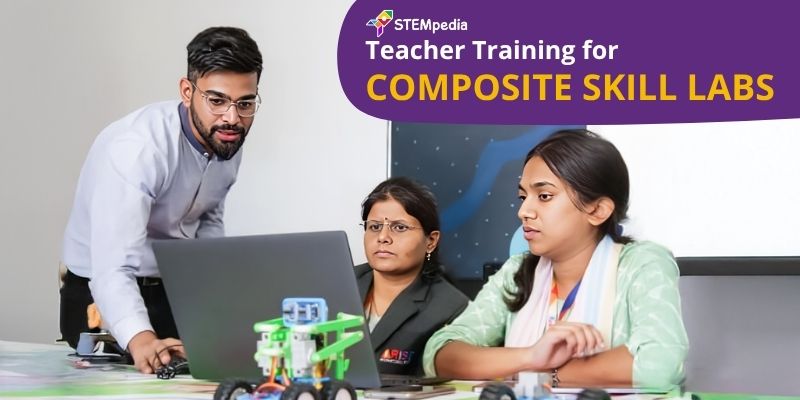
A Composite Skill Lab is more than a room containing computers, robotics kits, sensors, tools, and emerging technologies. Its success depends on the teachers who transform those resources into meaningful learning experiences.
Many schools invest in advanced infrastructure but struggle to use it regularly. Equipment remains stored, projects are limited to demonstrations, and practical sessions happen only before exhibitions or inspections.
The problem is rarely the technology itself.
It is often teacher readiness.
CBSE’s Composite Skill Lab guidelines identify curriculum, teacher training and staffing, timetable allocation, infrastructure and industry partnerships as essential components of skill education. Teachers are expected to be prepared in skill education, curriculum delivery, practical activities, and technical aspects.
Preparing teachers before the lab becomes operational is therefore as important as selecting the equipment.
Why Teacher Readiness Determines the Success of a Composite Skill Lab?
Consider two schools with similar infrastructure:
- Robotics kits
- Coding platforms
- Sensors and electronics
- AI software
- Computers
- Prototyping tools
- Flexible workstations
After six months, one lab is active throughout the week. Students are building projects, testing ideas, documenting their work, and presenting solutions.
In the other school, the equipment is used only during special events.
The difference is often teacher confidence.
Teachers who understand both the technology and the learning process are more likely to:
- Conduct regular practical sessions
- Encourage experimentation
- Troubleshoot basic problems
- Connect projects with academic subjects
- Manage group-based activities
- Assess the learning process
- Help students improve unsuccessful designs
Teacher training should therefore focus not only on how to operate equipment, but also on how to use it for purposeful, hands-on learning.
Why is Traditional Teaching Preparation Not Enough?

Composite Skill Labs introduce a different model of learning.
Instead of asking:
“What chapter should students memorize today?“
Teachers begin asking:
- What problem can students solve?
- Which tools should they use?
- How should teams collaborate?
- How can students test and improve their ideas?
- How should learning be assessed beyond written exams?
This shift requires teachers to become facilitators, mentors, and project guides rather than only content experts.
Skills Teachers Need for a Future-Ready Composite Skill Lab?
1. Project-Based and Experiential Pedagogy
Teachers must learn how to guide students through a complete project cycle:
Identify → Research → Plan → Build → Test → Improve → Present
Training should help teachers:
- Frame practical challenges
- Organise students into teams
- Assign meaningful responsibilities
- Encourage investigation instead of imitation
- Connect projects with academic concepts
- Guide reflection and improvement
- Manage different learning speeds
A Composite Skill Lab session should not become a product demonstration in which students only follow fixed steps. Students should understand the problem, make decisions, and explain their solutions.
2. Coding and Computational Thinking
Coding helps students control machines, automate systems, process information, and develop interactive solutions.
Teachers should be comfortable with:
- Sequencing
- Loops and conditions
- Variables
- Functions
- Algorithms
- Block-based programming
- Introductory Python
- Physical computing
- Debugging
The objective is not to memorise programming syntax. It is to understand how instructions, inputs and decisions produce an output.
Platforms such as PictoBlox can support a gradual progression from block coding to Python, robotics, AI, Machine Learning, IoT and physical computing.
3. AI and Responsible Technology Use
Teachers do not need to become AI researchers. However, they should understand how AI works in practice and where it can support different skill sectors.
Training may include:
- Basic AI concepts
- Data collection and labelling
- Machine Learning fundamentals
- Computer vision
- Speech and audio-based systems
- Generative AI awareness
- Model testing
- Accuracy and limitations
- Privacy, consent and fairness
- Responsible AI use
Teachers should be able to help students question an AI output instead of accepting it automatically.
For example, when an image-recognition model gives an incorrect result, students should examine the training data, lighting, camera angle, object position and category definitions before improving the model.
Read: AI in Composite Skill Lab – What CBSE Means by AI Infrastructure
4. Robotics, Electronics and Automation
For activities involving machines and materials, teachers should develop practical confidence in:
- Motors and movement
- Sensors
- Electronic circuits
- Controllers
- LEDs, buzzers and displays
- Wiring and connections
- Robotic mechanisms
- Automation workflows
- Basic hardware troubleshooting
With platforms such as Quarky, teachers can guide projects involving movement, sensors, displays, robotics and AI. Quarky Intellio can extend this learning towards camera-based projects, audio interaction, computer vision, augmented reality and intelligent robotics.
The aim is not to teach every component at once. Teachers should introduce systems gradually, beginning with simple input-output activities and progressing towards integrated projects.
5. IoT and Data-Based Projects
Internet of Things projects help students understand how connected devices collect information, communicate, and support decisions.
Teacher training can include projects such as:
- Environmental monitoring
- Smart irrigation
- Energy-use tracking
- School safety systems
- Home automation
- Temperature and moisture monitoring
- Data visualisation
- Remote alerts
These projects can connect coding and electronics with agriculture, sustainability, science, mathematics and community problem-solving.
6. AR, VR and Digital Learning Tools
Where suitable infrastructure is available, teachers can also use augmented and virtual reality to:
- Explore simulated workplaces
- Visualise machinery
- Understand engineering structures
- Practise procedures safely
- Present interactive models
- Create immersive learning experiences
These technologies should support a clear learning objective. They should not be introduced merely because they appear advanced or visually impressive.
7. Safety and Lab Management
Teacher readiness must include practical safety and operational planning.
Teachers should know how to:
- Store tools and components safely
- Supervise electrical and mechanical activities
- Maintain clear work areas
- Check equipment before sessions
- Manage charging and power supplies
- Use personal protective equipment where required
- Maintain inventories
- Report damaged equipment
- Conduct basic safety briefings
- Respond to minor incidents
CBSE’s Composite Skill Lab guidelines emphasise accessibility, safety, adaptability, storage, ventilation and appropriate workspaces for hands-on learning.
8. Practical Assessment
Written examinations alone cannot capture skill-based learning.
Teachers should assess:
- Understanding of the problem
- Planning and design
- Selection of tools
- Coding logic
- Safe working practices
- Testing
- Debugging
- Teamwork
- Documentation
- Communication
- Improvement after feedback
Assessment methods may include:
- Observation checklists
- Project portfolios
- Demonstrations
- Reflection notes
- Practical tasks
- Presentations
- Peer assessment
- Project rubrics
The NCF-SE approach, as reflected in CBSE’s guidelines, recommends observation, portfolios, and projects as important methods of vocational assessment.
How Does STEMpedia Support Teacher Readiness for CSL?

STEMpedia helps schools build the teaching capacity needed to operate Composite Skill Labs effectively throughout the academic year.
Support includes:
- Teacher onboarding before lab operations begin
- Hands-on training in coding, AI, robotics, electronics, PictoBlox, Quarky, and Quarky Intellio
- Guidance for interdisciplinary and project-based learning
- Grade-wise curriculum, lesson plans, and student activity resources
- Assessment frameworks and practical evaluation support
- Lab management, safety, troubleshooting, and classroom mentoring
- Refresher training and guidance for Kaushal Melas, exhibitions, and student showcases
By combining teacher development with infrastructure, curriculum, and continued implementation support, STEMpedia helps schools build active and sustainable skill-education programmes.
Want to Prepare Your Teachers for a Successful Composite Skill Lab?
Explore STEMpedia’s Composite Skill Lab solutions and book a demo to develop a confident, trained, and implementation-ready teaching team for your school.
Using Existing Labs for Teacher Preparation
Schools may already have an IT Lab, Atal Tinkering Lab, robotics lab or makerspace.
These spaces can support teacher training and specific CSL activities:
- IT Labs can support coding, AI, animation, data handling and digital projects.
- ATLs can support electronics, robotics, IoT, prototyping and automation.
- Makerspaces can support fabrication, design and interdisciplinary projects.
- Gardens and open spaces can support agriculture and environmental activities.
However, using an existing space does not automatically make it a complete Composite Skill Lab. Schools must still assess space, safety, storage, tools, selected sectors and multi-sector learning requirements.
Read: How Schools Can Use ATL, IT Labs and Makerspaces for CBSE Composite Skill Lab Setup?
Conclusion
A Composite Skill Lab is ultimately a learning ecosystem, not simply a physical space.
Robotics kits, AI platforms, coding software, sensors, and advanced technologies create opportunities, but it is teachers who transform those opportunities into meaningful learning experiences.
As CBSE schools expand skill education under NEP 2020 and NCF-SE 2023, investing in teacher readiness is one of the most important decisions school leaders can make. Teachers who are confident in technology, project-based pedagogy, and interdisciplinary learning can inspire curiosity, creativity, and innovation across classrooms.
The most successful Composite Skill Labs are not defined by the number of devices they contain; they are defined by educators who are prepared to guide students in exploring, building, testing, and solving real-world problems.
By combining thoughtful infrastructure planning with continuous teacher upskilling, schools can ensure their Composite Skill Labs remain active, relevant, and capable of preparing learners for the evolving world of work.
Frequently Asked Questions
1. Is teacher training mandatory for Composite Skill Labs?
Answer: CBSE’s implementation guidance emphasizes that schools should identify or appoint suitable teachers and ensure they receive training in pedagogy, curriculum delivery, practical work, and technical aspects to effectively operate Composite Skill Labs.
2. What should Composite Skill Lab teacher training include?
Answer: Training should cover AI, coding, robotics, electronics, IoT, AR/VR, project-based learning, classroom safety, assessment, interdisciplinary teaching, and practical classroom implementation.
3. How long should teacher training last?
Answer: A phased approach is generally more effective than a single workshop, beginning with foundational orientation and continuing through mentoring, classroom practice, and periodic refresher programs.
4. Why is teacher confidence important in a Composite Skill Lab?
Answer: Confident teachers are more likely to conduct regular hands-on sessions, encourage experimentation, troubleshoot challenges, and help students build practical skills through meaningful projects.
5. How can STEMpedia help schools build teacher readiness?
Answer: STEMpedia supports schools through teacher onboarding, hands-on AI and robotics training, curriculum resources, classroom mentoring, project guidance, assessment support, and continuous professional development aligned with Composite Skill Lab implementation.