Teacher Training for Composite Skill Labs – How Schools Can Build CSL Readiness?
July 29, 2026
Autonomous Cleaning Robots for Schools on Operating Budget · RobotLAB
August 4, 2026
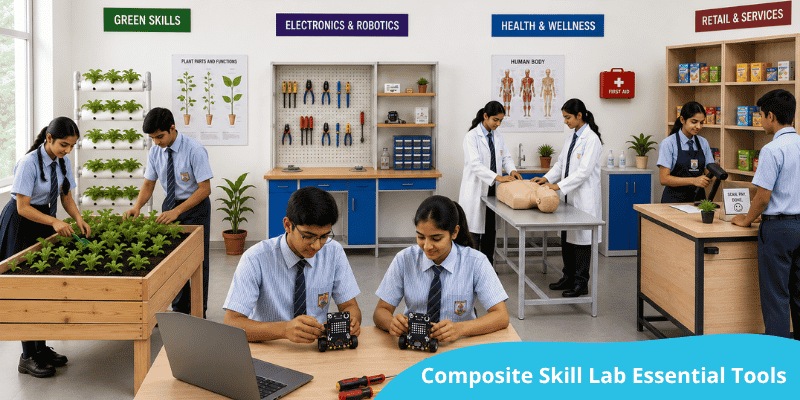
When schools begin planning a Composite Skill Lab, one of the first questions is usually:
What tools and equipment do we actually need?
The answer is not a single standard shopping list.
A Composite Skill Lab is designed to support practical learning across three Forms of Work:
- Work with Life Forms
- Work with Machines and Materials
- Work in Human Services
The required tools therefore depend on the skill sectors selected by the school, the students’ ages, the available space, teacher readiness, local relevance, class size, and the existing infrastructure.
CBSE’s guidelines include sector-wise tool lists covering Agriculture and Gardening, Food Production, Electronics and Mechatronics, Apparel, Automotive, Carpentry, IT/ITeS, AVGC and Media, Healthcare, Beauty and Wellness, Retail, and AI infrastructure. However, CBSE clearly states that these lists are suggestive and may be adapted according to each school’s readiness and requirements.
This article simplifies the official CBSE CSL equipment list into practical, school-friendly groupings of tools. It is intended for initial planning; schools should refer to the official guidelines before final procurement.
Essential Tools Across the Three Forms of Work
A CBSE Composite Skill Lab should provide practical tools across the three Forms of Work defined in the NCF-SE framework. The exact equipment should be selected according to the school’s chosen skill sectors, student age, existing infrastructure, safety requirements, and teacher readiness
1. Tools for Work with Life Forms
This area includes agriculture, gardening, food production, sustainability, plant nurseries, and related activities.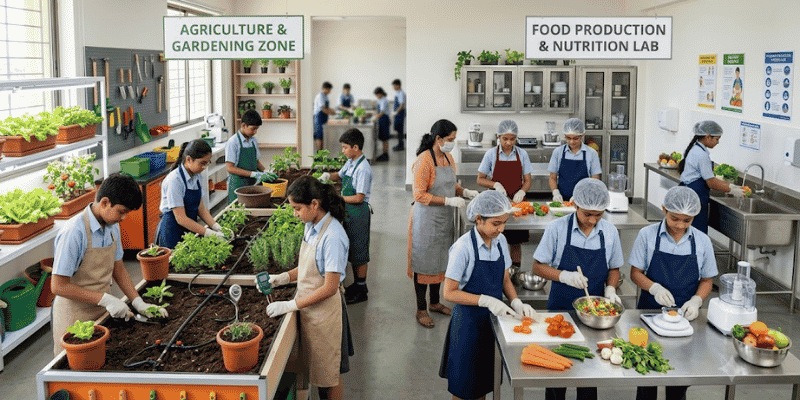
Agriculture and Gardening
Schools may require:
- Hand trowels, hoes, rakes, and gardening scissors
- Pots, trays, soil, seeds, and growing materials
- Gardening gloves and aprons
- Measuring tapes, beakers, thermometers, and humidity meters
- Watering tools and drip-irrigation kits
- Basic hydroponic equipment
These tools can support gardening, plant propagation, irrigation, soil observation, and environmental projects.
Food Production
Schools may require:
- Measuring cups, spoons, and digital weighing scales
- Knives, peelers, graters, sieves, and mixing tools
- Cooking vessels, pressure cookers, pans, and a stove
- Food-grade storage containers
- Plates, bowls, tongs, and serving equipment
- Aprons, gloves, head covers, and cleaning materials
Schools with a Home Science Lab may use it for selected food-production activities, but it does not automatically replace the complete Composite Skill Lab.
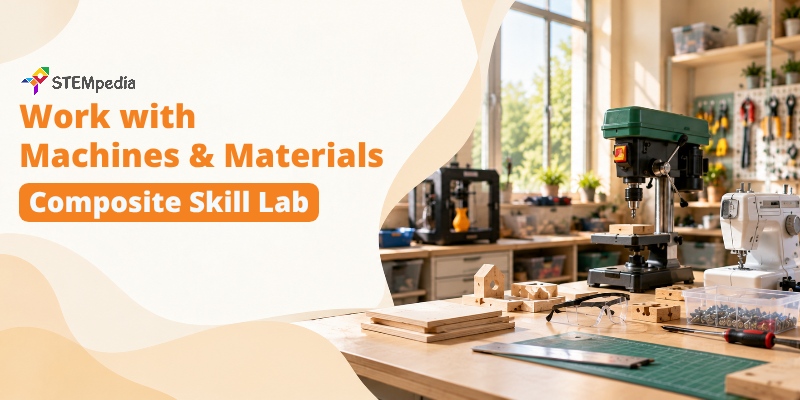
2. Tools for Work with Machines and Materials
This area includes electronics, robotics, coding, automation, apparel, automotive work, carpentry, IT, and digital media.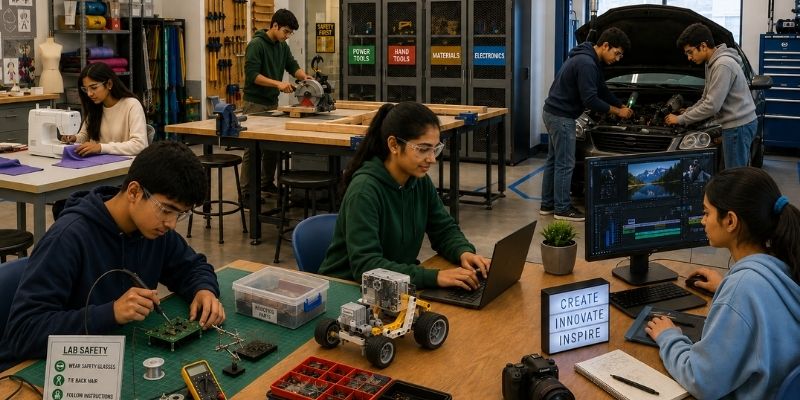
Electronics, Robotics, and AI
Schools may require:
- Microcontrollers and programmable boards
- Breadboards, wires, and electronic components
- Motors, LEDs, buzzers, and displays
- Temperature, humidity, distance, and light sensors
- Multimeters and voltage testers
- Screwdrivers, pliers, cutters, and glue guns
- Computers with coding and AI software
- Robotics and physical-computing kits
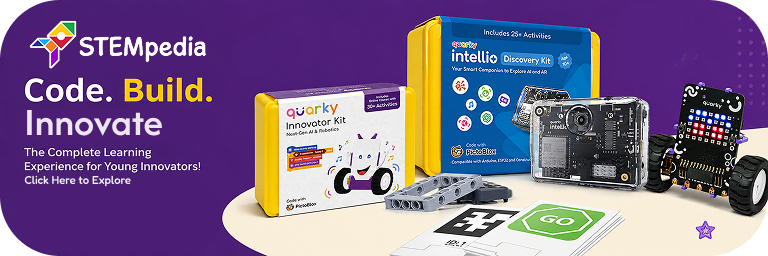
STEMpedia’s ecosystem can support this progression through:
Schools may add age-appropriate robotics and AI platforms when these tools are connected to curriculum and regular project work.
- PictoBlox for Block Coding, Python, AI, Machine Learning and physical computing
- Quarky for sensors, movement, robotics and hands-on AI projects
- Quarky Intellio for computer vision, audio interaction, AI, augmented reality and intelligent robotics
These platforms are implementation options and should not be presented as replacements for the complete CBSE sector-wise tool requirements.
For detailed planning, read: AI in Composite Skill Lab – What CBSE Means by AI Infrastructure.
Apparel and Fabric Work
Typical tools include:
- Measuring tapes and pattern-making tools
- Fabric scissors, needles, thread, and pins
- Embroidery hoops and printing blocks
- Fabric colours, brushes, and dyes
- Irons and ironing tables
- Sewing machines for advanced activities
Carpentry and Automotive Work
Depending on the selected sector, schools may require:
- Measuring tapes, steel rules, and try squares
- Saws, chisels, hammers, files, and hand drills
- Bench vises and sanding materials
- Spanners, screwdrivers, pliers, sockets, and gauges
- Mechanical assemblies or an old two-wheeler for demonstrations
These tools require trained supervision, secure storage, and clearly defined safety procedures.
IT and Media Equipment
Schools may use:
- Desktop computers or laptops
- Keyboards, mice, webcams, and headsets
- Reliable internet and power backup
- Coding, design, animation, and editing software
- Cameras, microphones, tripods, and lights
- Drawing tablets and external storage
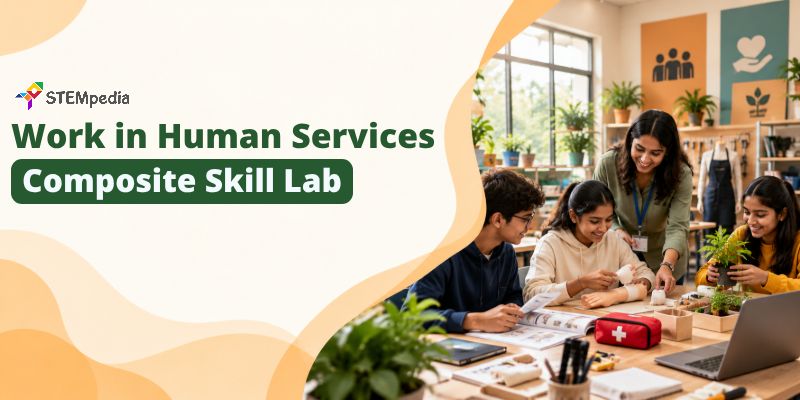
3. Tools for Work in Human Services
This area includes healthcare, retail, beauty and wellness, communication, and other people-focused services.
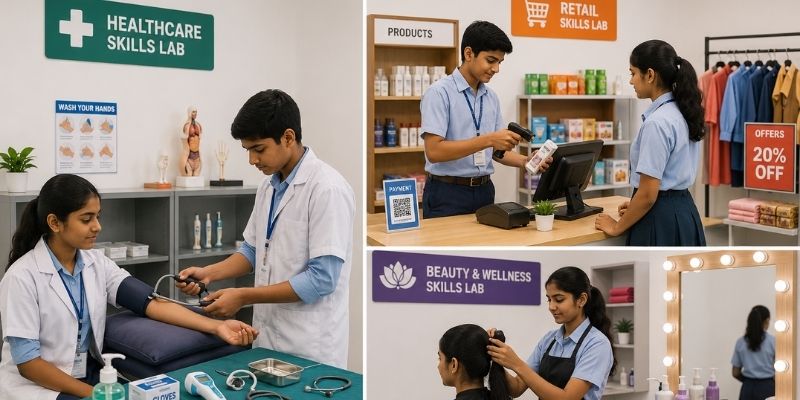
Suitable demonstration equipment may include:
- Digital thermometers
- Blood-pressure monitors
- Pulse oximeters
- Weighing scales and height-measuring tools
- CPR mannequins
- First-aid materials
- Gloves, masks, sanitisers, and PPE
Healthcare activities must remain age-appropriate, non-diagnostic, and supervised.
Retail
Schools may require:
- Computers with billing or POS software
- Barcode scanners
- Receipt printers
- Digital weighing scales
- Product racks and dummy products
- Promotional signage
- Inventory and billing materials
These tools can support customer service, merchandising, billing, inventory, mathematics, and entrepreneurship activities.
Beauty and Wellness
Illustrative equipment includes:
- Combs, brushes, mirrors, and spray bottles
- Manicure and pedicure sets
- Hair dryers and styling equipment
- Towels, aprons, capes, and hygiene supplies
- Adjustable chairs and organised workstations
Heat-based and electrical tools require direct supervision.
Can Schools Reuse Existing Equipment?
Yes. Schools should conduct an inventory before procurement.
CBSE permits existing spaces to support selected activities:
| Existing space | What it can support |
| School garden | Agriculture, gardening and biodiversity projects |
| ATL | Electronics, robotics, mechatronics, automation and IoT |
| IT Lab | Coding, AI, finance, animation and digital skills |
| Makerspace | Carpentry, fabrication, sewing, prototyping and 3D printing |
| Home Science Lab | Food production and baking |
| Single-sector lab | Existing healthcare, retail, automotive or beauty-and-wellness activities |
However, an IT Lab, ATL, Home Science Lab or single-sector lab does not automatically become a complete Composite Skill Lab. The broader CSL requirement remains unless a space fully satisfies the necessary infrastructure, safety, storage and multi-sector conditions.
For a detailed infrastructure audit, read: How Schools Can Use ATL, IT Labs and Makerspaces for CBSE Composite Skill Lab Setup.
Conclusion
A useful Composite Skill Lab tool list is not defined by the number of items purchased. It is defined by how effectively those items support practical learning across Life Forms, Machines and Materials, and Human Services.
Schools should begin by selecting relevant sectors, auditing existing resources and securing common infrastructure and safety equipment. They can then purchase foundational tool groups, run regular projects and expand into advanced equipment as teacher confidence and student capability grow.
The strongest Composite Skill Labs are not storage rooms filled with tools. They are active learning environments where students handle materials, build systems, serve people, test ideas and understand how different forms of work connect.
Want a Sector-Wise Tool Plan for Your Composite Skill Lab?
Explore STEMpedia’s Composite Skill Lab solution and book a demo to assess your existing infrastructure, select appropriate skill sectors and create a phased equipment plan for your school.