How to Introduce Robotics to Kids at Home and Schools?
July 18, 2026
Teacher Training for Composite Skill Labs – How Schools Can Build CSL Readiness?
July 29, 2026
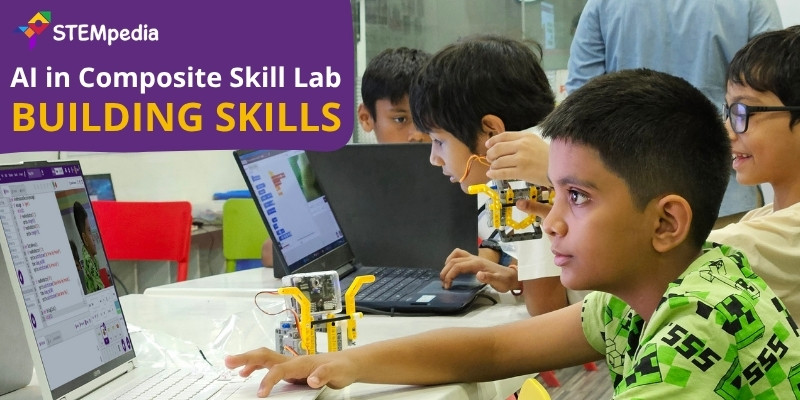
A child growing up today will not encounter artificial intelligence only in a computer class.
AI may help a farmer understand crop conditions, support a healthcare worker, improve product design, automate a machine, assist a customer, or make public services more accessible. The real question for schools is therefore not simply, “Should students learn AI?” It is, “Will they learn to use it thoughtfully, practically, and responsibly?”
This is the larger purpose behind AI in Composite Skill Lab implementation.
CBSE’s Composite Skill Lab guidelines contain a dedicated section on integrating artificial intelligence. The Board urges affiliated schools to establish AI infrastructure within Composite Skill Labs so that students can apply emerging technologies across different skill subjects.
The intention is not to turn every student into an AI engineer. It is to help students understand how technology can strengthen human skills, solve practical problems, and create new possibilities across the world of work.
What does AI Integration mean in the CSL context?
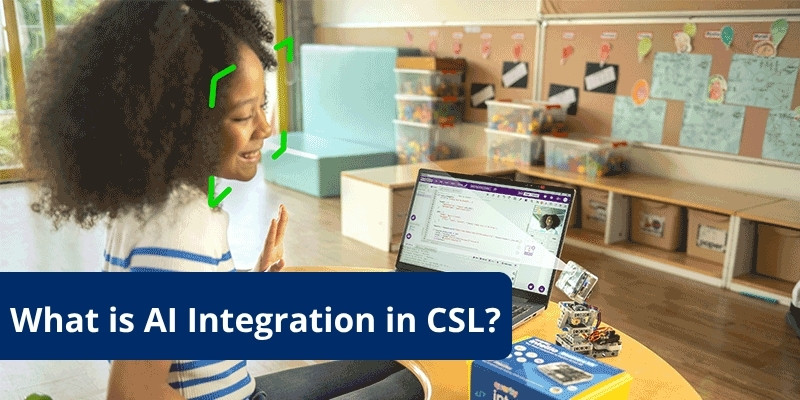
AI integration does not mean placing a few computers in one corner of the lab and adding “Artificial Intelligence” to the timetable.
It means enabling students to use AI as a practical tool within the skills they are already exploring.
A student learning agriculture might use data from soil and environmental sensors. A student studying retail could explore product recognition or demand patterns. A healthcare project might examine how technology can support reminders, accessibility, or basic non-diagnostic monitoring. A robotics project might use vision, sound, or object recognition to respond to its environment.
AI therefore becomes a connecting layer across different areas of work.
CBSE describes the Composite Skill Lab as a flexible, multi-sector space supporting hands-on learning across fields such as electronics, healthcare, agriculture, apparel, food production, IT/ITeS, AI, and AVGC. The lab is intended to bring “making and thinking” together rather than treating practical and academic learning as separate experiences.
AI in a CSL should help students:
- Observe a real problem
- Collect or interpret information
- Design a possible solution
- Build and test a prototype
- Examine whether the solution is useful
- Understand the limitations of technology
- Improve the project through evidence and feedback
This is AI-enabled skill education: students learn not only what AI is, but where it can be useful, where it can fail, and how it should be applied responsibly.
Why has CBSE included AI in CSL?
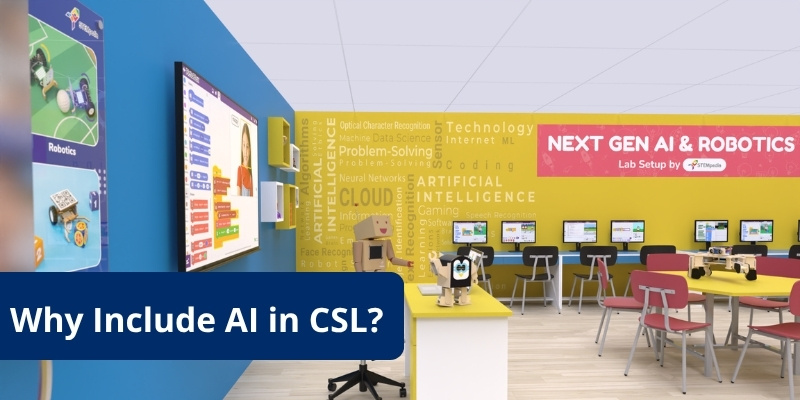
CBSE’s decision reflects a larger change in work.
Technology is no longer restricted to software companies. It now supports agriculture, manufacturing, healthcare, finance, media, retail, tourism, design, transportation, and public services.
For schools, this creates an important responsibility.
Students should not leave school believing that AI belongs only to coders or highly specialised professionals. They should understand how it interacts with different vocations and how human judgement, domain knowledge, creativity, and ethics remain essential.
AI inclusion helps schools move from:
| Traditional approach | AI-enabled skill education |
| Learning software commands | Solving practical problems |
| Working in one isolated subject | Connecting multiple disciplines |
| Following fixed instructions | Testing and improving solutions |
| Consuming digital technology | Creating with digital technology |
| Focusing only on correct answers | Examining accuracy, bias and limitations |
| Treating AI as a future topic | Understanding its present-day relevance |
A future-ready skill lab therefore does not prepare students for one specific job. It develops adaptable learners who can understand new tools and apply them across changing situations.
How AI connects to the Three Forms of Work?
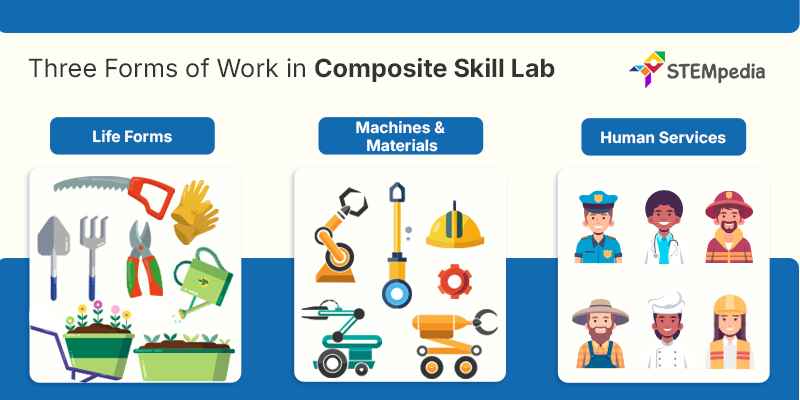
The NCF-SE framework organises vocational education around three forms of work. CBSE specifically places AI applications across all three.
1. Work with Life Forms
This includes areas such as agriculture, floriculture, gardening, animal husbandry, food-related activities, and environmental work.
Possible school-level AI applications include:
- Studying plant health through images
- Using sensor data to understand soil conditions
- Creating smart irrigation alerts
- Identifying patterns in temperature or moisture readings
- Sorting fruits, leaves, or seeds by visible features
- Monitoring environmental conditions in a small growing area
The educational purpose is not to replace observation or agricultural knowledge. It is to show students how data and technology can support better decisions.
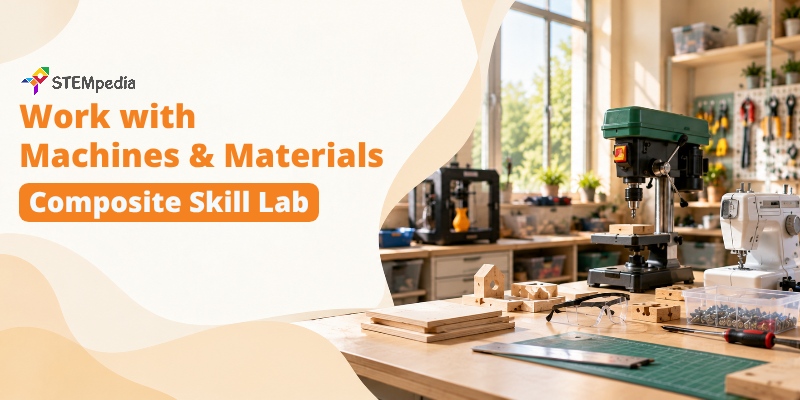
2. Work with Machines and Materials
This form of work includes mechatronics, electronics, robotics, electrical work, coding, fashion design, carpentry, automation, and other technology- or material-based activities.
Possible applications include:
- Robots that recognise objects
- Systems that respond to voice or gestures
- Visual inspection of products or materials
- Smart safety alerts
- Automated sorting models
- AI-supported design and prototyping
- Machines that react to their surroundings
This is where an AI and robotics lab for schools can strongly support the Composite Skill Lab. However, robotics should remain connected to broader skill problems rather than functioning only as an isolated demonstration.
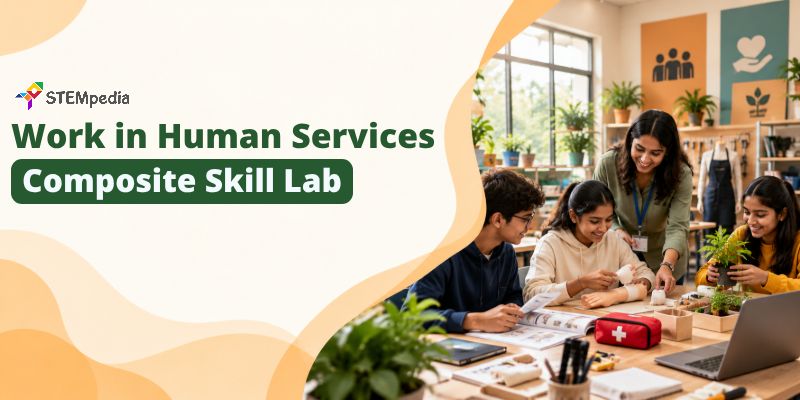
3. Work in Human Services
This includes healthcare, finance, tourism and hospitality, retail, e-commerce, communication, and other people-focused services.
Possible applications include:
- Accessibility tools
- Multilingual information systems
- Smart assistance for school visitors
- Customer-service simulations
- Product recommendation exercises
- Data-based planning for school events
- Simple service-delivery prototypes
Students should also understand the importance of privacy, fairness, consent, accuracy, and human supervision when AI is used in people-centred services.
To understand how schools can use existing ATLs, IT Labs, and Makerspaces to support these areas within a Composite Skill Lab, read our detailed guide: How Schools Can Use ATL, IT Labs, and Makerspaces for CBSE Composite Skill Lab Setup.
What Schools Can and Cannot Do?
Schools Can
- Introduce AI through interdisciplinary projects.
- Begin with shared systems and expand in phases.
- Leverage suitable IT Lab, ATL, robotics, or mechatronics resources.
- Select projects according to local needs and student aspirations.
- Connect AI with agriculture, healthcare, retail, design, electronics, and other sectors.
- Use project portfolios, observation, presentations, and demonstrations for assessment.
- Combine AI education with entrepreneurship and community problem-solving.
Schools Should Not
- Treat generative AI or chatbots as the complete meaning of AI education.
- Assume that purchasing computers automatically creates AI infrastructure.
- Restrict AI entirely to a computer science period.
- Use an IT Lab as a substitute for the complete multi-sector Composite Skill Lab.
- Rename an existing ATL as a CSL.
- Introduce cameras or data-based tools without privacy and supervision practices.
- Select highly technical tools without considering students’ ages and teachers’ readiness.
- Build an impressive lab that remains disconnected from the timetable and curriculum.
CBSE permits existing IT Labs to support computer-based subjects such as AI, coding, finance, animation, and multimedia. However, the guidelines clearly state that an IT Lab cannot be converted into a Composite Skill Lab. Similarly, an ATL can support mechatronics and electronics activities but cannot replace a CSL when established as a government-funded facility for a specific purpose.
AI Infrastructure Planning and Comparison
| Planning area | Basic implementation | Integrated implementation | Mature implementation |
| Computing | Shared computers | Dedicated team workstations | Flexible multi-project systems |
| AI learning | Guided visual activities | AI models linked to projects | Student-designed applications |
| Robotics | Optional introduction | Sensors, robots and automation | Cross-sector intelligent systems |
| Curriculum | Introductory modules | Grade-wise project progression | Interdisciplinary problem-solving |
| Teachers | Initial orientation | Practical implementation training | Mentoring and project facilitation |
| Assessment | Worksheets and demonstrations | Portfolios and project rubrics | Exhibitions, reflection and impact review |
| Student role | Learner | Builder | Problem-solver and innovator |
The correct stage depends on the school’s readiness, selected skill sectors, teacher capacity, existing equipment, timetable, and budget.
How does STEMpedia Support AI-Enabled CSL?
STEMpedia helps schools establish, operate, and sustain CBSE-aligned Composite Skill Labs in line with NEP 2020 and NCF-SE 2023.
Support includes:
- Auditing existing IT Labs, ATLs, robotics labs, and makerspaces
- Planning lab layouts, AI workstations, tools, and infrastructure
- Integrating PictoBlox, Quarky, and Quarky Intellio for coding, AI, robotics, IoT, and physical computing
- Providing grade-wise curriculum, projects, assessments, and teacher resources
- Conducting practical teacher training and continued implementation support
- Supporting student showcases, Kaushal Melas, exhibitions, and project portfolios
STEMpedia helps schools move beyond isolated technology activities and build a structured, future-ready learning ecosystem where students understand real problems, develop solutions, test their ideas, and improve their projects.
Want to Set Up a CBSE Composite Skill Lab?
Explore STEMpedia’s Composite Skill Lab solutions and book a demo to plan a practical, sustainable, and AI-enabled lab for your school.
Conclusion
CBSE’s inclusion of AI in Composite Skill Labs is not about adding another technology subject. It is about helping students use AI to explore real problems, build meaningful solutions, and understand technology responsibly.
With the right infrastructure, curriculum, teacher support, and hands-on projects, schools can prepare learners to approach the future with curiosity, creativity, confidence, and sound judgement.
FAQs
1. Is AI infrastructure mandatory in a CBSE Composite Skill Lab?
Answer: CBSE mandates Composite Skill Labs for applicable affiliated schools. In its implementation guidelines, CBSE separately urges schools to establish AI infrastructure within CSLs. The guide does not describe AI infrastructure as an independent lab mandate with one fixed compulsory equipment package.
2. What does CBSE mean by AI infrastructure?
Answer: CBSE describes it as infrastructure that enables students to build AI skills, apply emerging technologies in different skill subjects, create solutions for social challenges, and develop entrepreneurial capabilities.
3. What computer equipment does CBSE suggest for AI integration?
Answer: The annexure provides a suggested reference of three to five desktops and three to five laptops. It recommends modern processors, 16 GB RAM, 1 TB SSD storage, updated operating systems and browsers, webcams, and external backup storage. These are suggestive specifications.
4. Is an AI and robotics lab the same as a Composite Skill Lab?
Answer: No. An AI and robotics lab generally focuses on technology-related activities under Work with Machines and Materials. A Composite Skill Lab must support multi-sector skill education across all three forms of work.
5. How can STEMpedia support AI integration in a CSL?
Answer: STEMpedia’s implementation model can include infrastructure planning, AI and robotics tools, PictoBlox-based learning, curriculum, projects, teacher training, assessments, and continued implementation support. Exact deliverables should be confirmed against the current STEMpedia proposal.